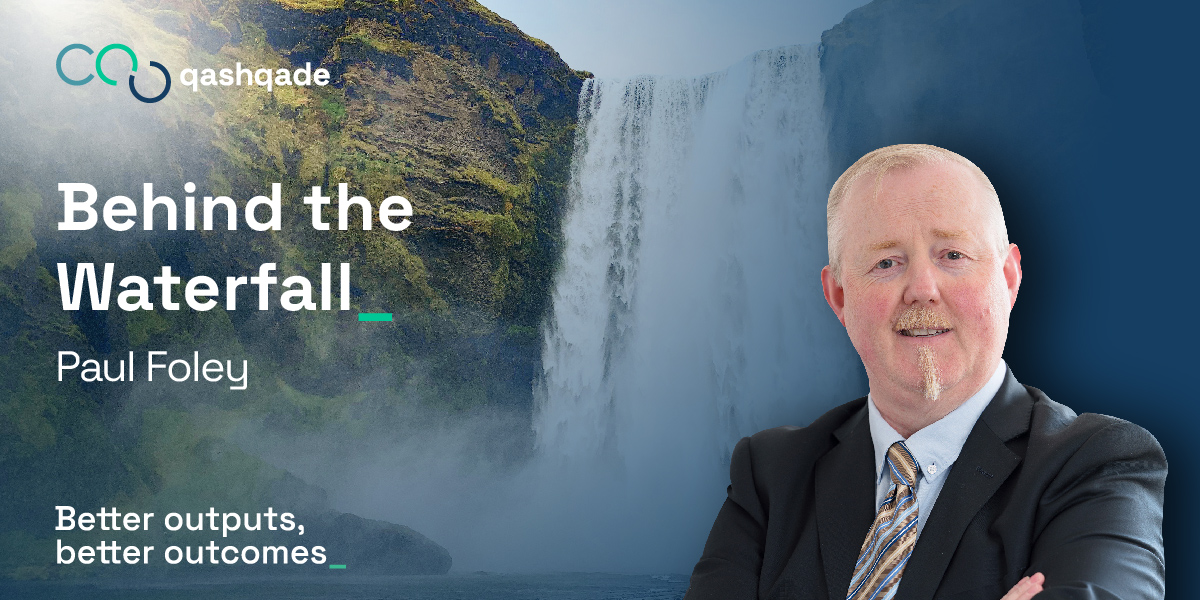

Before qashqade, our CTO Paul Foley spent two decades across trading, wealth management, private banking, institutional crypto and even the United Nations. In our latest edition of Behind the Waterfall, he talks about what that unusually global, cross-sector path teaches you about building mission-critical systems, and why he doesn’t see innovation, stability and security as competing objectives.
You’ve had a remarkably diverse career, including time at the United Nations. How did that journey lead you to qashqade?
My career has taken me through international institutions, financial services and startup environments, but there has been a consistent thread: using technology to solve complex problems with real-world consequences.
Working at the United Nations gave me a genuinely global perspective. It taught me how to operate across cultures, institutions and competing priorities, and how important it is to build systems that work for many different stakeholders, not only for the people designing them.
Later, in financial services and startup leadership roles, I became increasingly interested in the gap between what technology could achieve and what many firms were still forced to manage through fragmented systems and manual processes. qashqade stood out because it was addressing exactly that kind of problem in private markets. It combined deep technical complexity, meaningful client impact and the opportunity to help build and scale a company. That combination was very compelling to me.
What skills or perspectives from your earlier roles do you find yourself using most as CTO today?
The global perspective is probably the most important. Technology may be universal, but the way people use it – and the regulatory, operational and cultural context around it – is not. As CTO, I need to understand how decisions made at the architectural level affect clients operating in very different markets.
My earlier roles also taught me how to translate between different worlds: technology, business, operations and governance. A CTO cannot focus only on the elegance of the architecture. You have to understand the client’s problem, the commercial context and the consequences if the system fails.
Finally, startup experience taught me pragmatism. You need a bold vision, but you also need the discipline to deliver value incrementally. The best technology strategy is not the one with the most ambitious diagram; it is the one that consistently turns ambition into outcomes for clients.
How do you approach building technology for a highly regulated, global industry like private markets?
We begin with trust. In private markets, the platform is working with highly sensitive data and calculations that can have significant financial, legal and reputational consequences. Accuracy, traceability and resilience therefore cannot be features added at the end, they have to shape the architecture from the beginning.
We also design for complexity without allowing the product itself to become unnecessarily complicated. Private markets structures vary enormously across jurisdictions, asset classes and individual agreements. The challenge is to represent that complexity faithfully while giving users a controlled and understandable workflow.
Most importantly, every result has to be explainable. Clients need to know not only what the answer is, but how the platform arrived at it. That means deterministic logic, clear audit trails and strong governance around data and calculation rules. In a regulated industry, transparency is part of the product.
How do you balance innovation with stability and security in the platform?
I do not see innovation, stability and security as competing objectives. Sustainable innovation depends on a stable and secure foundation.
The balance comes from being deliberate about where and how we introduce change. We can experiment quickly, but anything entering a critical workflow must meet a much higher standard. It has to be tested, observable, recoverable and secure by design. We separate experimentation from the deterministic core of the platform and introduce new capabilities through controlled, measurable steps.
That discipline actually allows us to move faster over time. When the architecture, controls and engineering practices are strong, teams can innovate with confidence rather than treating every release as a risk. The objective is not simply to release more technology, it is to create useful progress that clients can trust.
AI adoption in financial services comes with both real opportunity and real risk. Where do you see the most promising use cases for AI and automation in private markets technology today, and what should firms be careful about as they integrate it into existing infrastructure?
The most promising near-term use cases are those where AI helps people navigate complexity: extracting information from documents, accelerating data mapping, identifying anomalies, summarising large volumes of material and making sophisticated platforms easier to use. There is also enormous potential for intelligent interfaces that allow users to interrogate data and workflows more naturally.
However, it is important to distinguish between probabilistic assistance and deterministic execution. An LLM can be extremely effective at interpreting, suggesting or highlighting, but a legally and financially consequential calculation must be reproducible, explainable and auditable every time. That is why we see AI as an intelligent layer around controlled calculation infrastructure, not as a replacement for it.
Firms should also resist integrating AI simply because it is available. They need to understand where data is going, how outputs are validated, who remains accountable and what happens when the model is wrong. The right question is not, “Where can we add AI?” It is, “Where can AI create measurable value without weakening control?”
What is the one thing that makes qashqade genuinely different from other players in the private markets ecosystem?
For me, it is that qashqade combines purpose-built technology with genuine private markets expertise.
We are not putting a modern interface over spreadsheet logic, nor are we handing clients a generic toolkit and asking them to encode every rule themselves. The platform is built around a dedicated, deterministic calculation engine designed for the economic structures of private markets. That produces results that are repeatable, traceable and defensible.
But technology alone is not enough. Translating an agreement into a reliable operational model requires domain knowledge. By combining the platform with people who understand fund structures and allocation logic, we help clients move from fragile, person-dependent processes to infrastructure they can trust and scale. That combination is difficult to replicate.
What excites you most about the technical challenges qashqade is tackling right now, from scaling the platform to bringing automation and LLM capabilities into the workflow?
What excites me is that these are not abstract technical challenges. Every improvement can remove operational risk, save highly skilled people from repetitive work and give clients greater confidence in decisions involving substantial value.
Scaling the platform means more than handling additional volume. It means supporting greater structural complexity, more integrations and a growing global client base without compromising performance, security or explainability. That is an ambitious engineering problem.
At the same time, automation and LLMs give us the opportunity to rethink how users interact with complex financial systems. We can reduce the distance between a question and a reliable answer, make institutional knowledge more accessible and automate parts of the workflow that have historically required significant manual effort. The key is to do this while preserving a clear boundary between intelligent assistance and controlled execution. If we get that right, we can fundamentally improve how private markets operate.
If someone were considering joining qashqade, what would you say makes it a great place to grow?
qashqade offers the opportunity to work on difficult, meaningful problems at a point when both the company and the industry are evolving rapidly. The technical challenges are substantial, but so is the potential impact.
Because we are building and scaling, people have genuine scope to shape the platform, our ways of working and the direction of the company. You are not confined to a narrow role or maintaining something whose important decisions were made years ago. You can take ownership, test ideas and see your work reach clients.
It is also an environment where different perspectives matter. We operate globally and bring together technology, financial expertise and client experience. For someone who is curious, ambitious and comfortable learning across disciplines, that creates tremendous room for growth. You can deepen your craft while helping build infrastructure for the future of private markets.