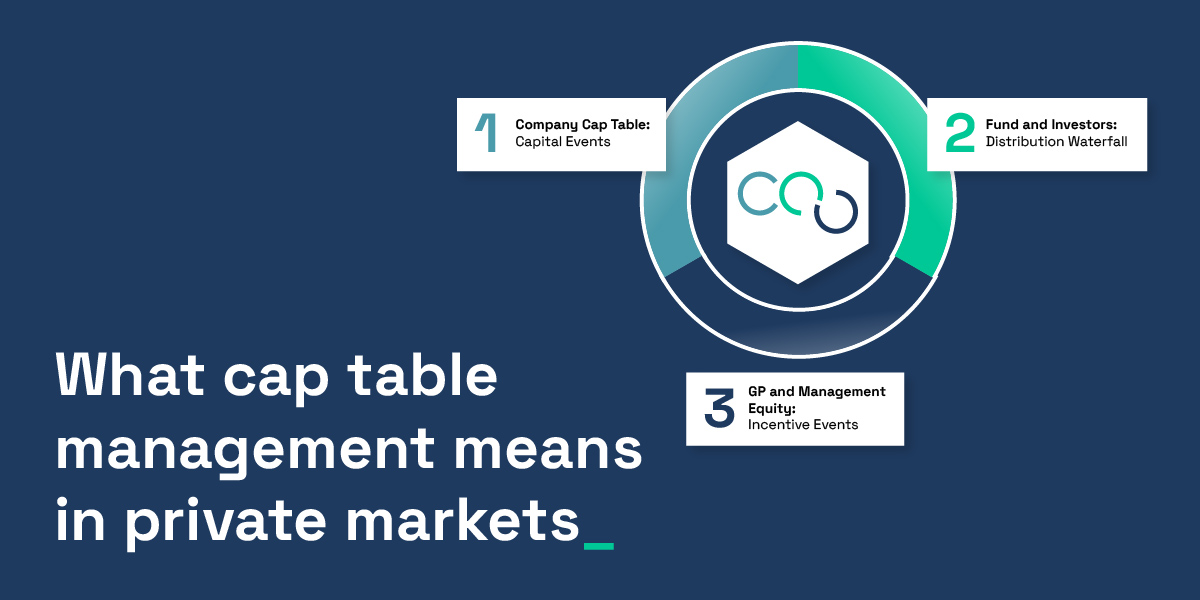

Ask a venture investor, a private equity CFO and a fund administrator what a “cap table” is, and you might get three different answers. Each is correct, however a lot of confusion comes from not knowing exactly which one is meant. This first article in our series explains the three meanings of cap table management in private markets with examples, then looks at the main challenges.
The basics. A cap table (capitalization table) lists every holder of a company, what each holds and the resulting ownership percentage, and lets you see the impact of events such as a funding round or an exit. Every new share issued has the potential to dilute existing owners’ ownership and control, and the fully diluted view counts all issued shares together with all rights to acquire shares in future (Harper James). In private markets, investment firms (GPs) raise money from outside investors (LPs) into a fund and use it to buy stakes in unlisted companies. When the fund sells a stake, that is an exit, and money flows back. That chain, from company to fund to investor and GP, is why one phrase can mean three things.
The three meanings at a glance
| Meaning | What is tracked |
| 1. Company cap table | Who owns what in a company: percentages, voting and control, share classes, preferences |
| 2. Fund and investors | Who the investors are, what each committed, and what each receives |
| 3. GP and management equity | Management incentive plans, carry allocations, vesting, and how they dilute |
Meaning 1: the company cap table or share registrar
This is the one most people picture: who owns what in a single company, across founders, employees, investors and the different classes of shares they hold. Preferred shares often carry a liquidation preference, which prioritises those investors over other shareholders when the company is sold. Whether the preference is participating or non-participating changes what the investor receives (Taylor Wessing).
An illustrative example. A company has 1,000,000 shares: the founders hold 800,000 and 200,000 are set aside for staff as options. An investor puts in $5 million at a $15 million pre-money valuation, which is $15 per share, and receives about 333,333 new shares.
The founders keep the same number of shares, but their percentage falls from 80% to 60%. That is referred to as dilution.
Meaning 2: the fund and investor view
Here the question becomes “who owns the fund, and what do they receive?” This view tracks the LPs, what each committed, the capital calls and the distributions. Distributions follow a waterfall, the order in which proceeds are paid out. Every fund’s Limited Partnership Agreement differs, which is why these calculations are hard to standardise.
Meaning 3: GP and management equity
The third meaning concerns the people who run the fund and the companies it owns. Vesting and leaver terms, usually split into good and bad leavers, decide what a departing manager keeps. On the GP side, carry holders share in the fund’s carried interest, usually subject to vesting.
An illustrative example. A partner is allocated carry points that vest over several years. When a new partner joins, existing partners can be diluted, or the new points can come from a reserve. When someone leaves, their vesting schedule decides how much they keep.
The main challenges
- Many systems, one answer. Holdings, fees and carry data sits across deal teams, finance and administrators. Manual collection and use of portfolio company data are common pain points in private equity, and mapping data for new reporting standards often exposes inconsistencies between systems (KPMG Luxembourg, November 2025).
- Management equity keeps moving. Joiners and leavers change who holds what, and leaver terms differ: three categories in typical UK practice, two in the US (Davis Polk). Finance and HR need to work from the same numbers.
- Reports that cannot be compared. “No two fund managers report in the same way”, and until standard templates are universally adopted, allocators still have to reconcile data sets, often by consolidating them into spreadsheets by hand (Nasdaq, August 2026).
- Checking, not just receiving. ILPA’s reporting template standardises the disclosure of fees, expenses and carried interest, but ILPA states it was not designed for verifying any of the GP’s calculations (ILPA). LPs who want to check what they pay need a way to do so independently.
- One process, many funds. Adapting reports to each fund can be cumbersome given varying deadlines and investor expectations (KPMG Luxembourg, November 2025), while rising data volumes and fragmented systems put pressure on running complex fund platforms reliably at scale.
The common thread between these challenges is the same: numbers that have to travel between views, and checks that still have to be done by hand.
Why the three meanings are really one chain
Follow a single euro through the system. LPs give money to the fund. The fund buys shares in a company, which appear on that company’s cap table. At an exit, the sale price is divided among all holders according to the cap table and the preferences. The fund then receives its part, which is divided again between LPs and the GP according to the waterfall, with carry flowing on to the carry holders. An error at any step flows through to everything after it.
So whenever you hear the term, it is worth asking: which cap table do we mean, and do the three views agree? It is the thinking behind how we approach cap table management at qashqade: one calculation engine for every view of ownership, covering the company, the fund and GP equity.
Interested in seeing cap table management in action? Book a demo with our team!