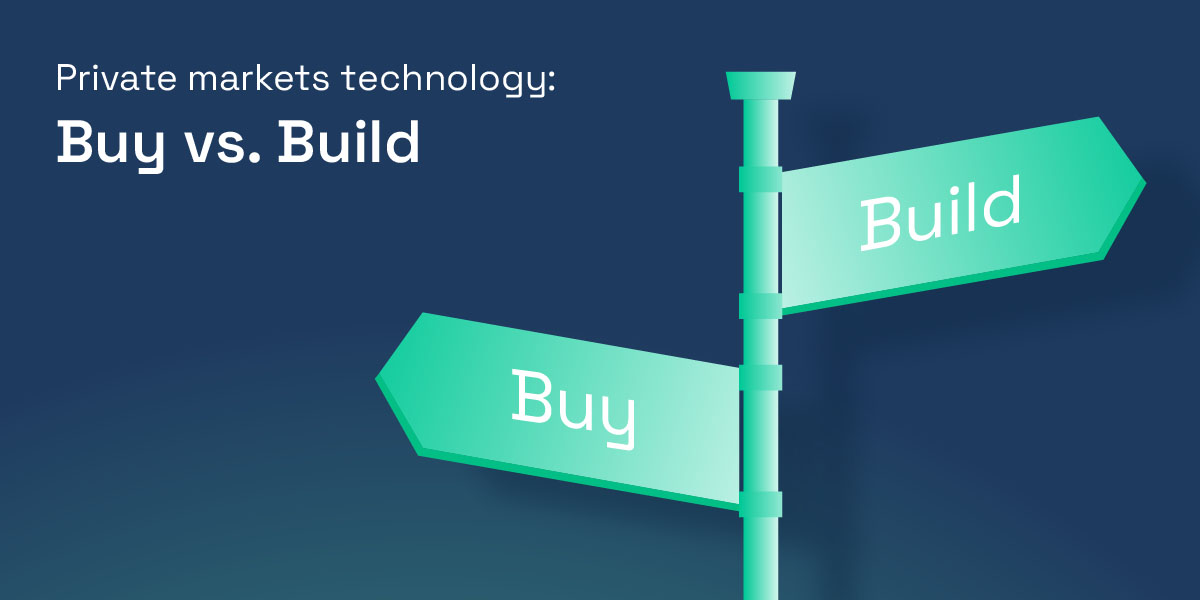

Back in August 2023, we published a piece on the build-vs-buy question for private markets technology. The core arguments we made then around cost underestimation, expertise risk, and the false promise of perfect bespoke functionality, remain as valid today as they were when we wrote them. We have kept that original post live because it still stands on its own terms.
But the landscape has shifted in one important way. Generative AI has introduced a new variable into the equation. A growing number of private markets firms are now asking not just whether to build, but whether AI tools make building cheaper and faster enough to change the answer.
This post will cover familiar ground on costs, expertise, and functionality but through a 2026 lens. And we will introduce a dimension that our original post did not address in depth: risk. In particular, the compliance, operational, and LP-facing risk that no AI tool can eliminate.
The question is the same but the stakes are higher
The build-vs-buy question has never been more charged for private markets firms. It arises, as it always has, when a specific operational problem makes a purpose-built internal solution feel like the logical answer, often perceived as cheaper or better-fitted than anything available off the shelf.
Private markets organisations are rarely resourced with in-house development teams. Therefore for most organisations building means outsourcing to a third party or, increasingly, assembling something internally with the help of AI coding tools. The scope of the question covers everything from AML and compliance tooling to fund accounting, waterfall calculation, and LP reporting.
The harsh reality has not changed: most large internal IT projects fail. The reasons are well-documented, systematic underestimation of time and resource, failure to treat development as a long-term ongoing commitment rather than a one-time project, and the compounding cost of maintenance and iteration. What has changed is that generative AI has made the initial stages of a build project feel deceptively accessible. A working prototype can appear in days. What it obscures is everything that happens next.
Costs
What “Buying” actually costs
Enterprise SaaS for private markets carries real costs: annual license fees that scale with team size, implementation charges, onboarding, and training. When an off-the-shelf product does not map cleanly to your workflows, there are further costs in product customisation, delayed implementation, and the organisational change management required to bridge the gap between expectation and reality. These are legitimate criticisms of the buy route, and any vendor who dismisses them is not being straight with you.
The bill AI self-build doesn’t erase
The cost of building a custom solution has always been underestimated, even by organisations whose entire focus is software development. For a private markets firm whose core business is investments, not technology, the risk of significant cost overrun with limited useful output is substantially higher.
The costs in question are not limited to engineering. They include the search and placement of the right talent; the time that talent spends understanding, documenting, building, and testing; the ongoing cost of maintenance; and the operational cost of running without a production-grade solution during development.
The rise of generative AI has introduced a new cost illusion. A manager can now come up with an LP reporting tool in days rather than months. But what AI cannot generate is the years of edge-case resolution, audit-trail design, and compliance validation that underpin a production-grade system. Those hidden costs, stress-testing against hundreds of LPA structures, mapping to evolving regulatory requirements, maintaining uptime SLAs, are just as real in the AI era as they were before it. And AI cannot simply replace years of expertise based on reading thousands of industry specific documents and implementing hundreds of structures and models.
Expertise
The expertise you don’t have to build
When you purchase a purpose-built solution in a known market, you are acquiring more than software. You are accessing the accumulated expertise of the vendor and, indirectly, of every client whose edge cases and requirements have shaped the product over time. This is the economic logic of specialisation: the bought product embeds lessons that would cost you significantly more to learn yourself.
That said, buying does not eliminate the need for internal expertise. The solution still needs to be configured, used effectively, and embedded into the organisation. The required expertise shifts rather than disappears and positioning it correctly within the business is a real implementation challenge.
The AI-era key-person problem
The intuitive appeal of building is straightforward: you know your own requirements better than anyone. A bespoke solution can be designed precisely to your workflows, and there may even be ambitions to monetise it through an API or as a standalone product.
The structural problem is that if you succeed, you will never be able to hire someone who already knows your platform. The expertise your team builds is fully proprietary which means key-person risk is embedded in the architecture of the decision.
In the AI-assisted build scenario, this risk intensifies. A bespoke system built with the help of AI tools may be comprehensible only to the engineer who assembled it and poorly documented because the speed of development made documentation feel optional. When that person leaves, the fund is not just short a developer, but the entire operational logic of its own platform.
Beyond key-person risk, there is the opportunity cost of expertise itself. The people capable of specifying and overseeing a build project are, by definition, the people whose time is most valuable elsewhere in the business. Using that expertise to build an internal system means it is not being used for the purpose it was originally hired for. Unless you are confident that the build creates more value than the expertise it consumes and that you can scale that expertise fast enough to avoid gaps in either the project or the business the calculus rarely favors building.
Functionality
An investment in future-proof infrastructure
Not every SaaS solution offers a one-size-fits-all approach and in private markets in particular, niche providers often address very specific aspects of a broader workflow. The value of working with a focused technology provider, however, is not just what their product does today but instead what they will build next, partly in response to your input.
Technology vendors actively solicit customer feedback because client requirements shape the product roadmap and features that serve one client often serve many. In practice, this means that well-communicated requirements frequently make it into the product without additional cost to the client. That is a fundamentally different dynamic from commissioning custom development, where every new requirement carries a direct price tag.
Outpaced before you launch
If the available solutions feel like a poor fit for your specific requirements, building appears to be the only route to the functionality you need. That logic frequently underestimates the time involved.
Custom functionality takes time to build, test, and maintain. In fast-moving markets, that time cost means your bespoke tool may be outdated by the time it is production-ready, while competitors who bought are already operating on the platform. Keeping up is always more expensive than anticipated, and there is rarely a clean exit from the commitment once it has been made.
Risk: the dimension that AI cannot eliminate
Of all the arguments in the build-vs-buy debate, risk is the one most consistently underestimated and the one that has grown in importance as AI-assisted development lowers the perceived barrier to building.
Operational risk sits with you when you build
When a private markets firm builds its own system, whether with traditional development or AI assistance, it assumes full operational responsibility for the outputs of that system. That responsibility extends well beyond whether the software runs. It covers whether the software produces results that can be defended to LPs, auditors, and regulators.
A waterfall calculation that produces the wrong carried interest split is a liability. When the system is bespoke, there is no vendor standing behind it with a documented methodology or an audit trail. The firm bears the consequence in full.
SOC 2 certification: what it means in practice
qashqade is SOC 2 certified. That certification is the output of an independent audit verifying that the platform meets rigorous standards for security, availability, processing integrity, confidentiality, and privacy.
For any fund manager evaluating a build option, the relevant question is clear: can you achieve an equivalent level of independently verified assurance for your bespoke system, within your budget and timeline? For the overwhelming majority, the honest answer is no.
The AI-build risk that nobody talks about
There is a specific risk profile that deserves direct attention in 2026. A growing number of private markets firms are exploring whether a combination of off-the-shelf AI tooling and internal prompting can substitute for purpose-built, validated financial software.
The output of such a process has not been stress-tested against hundreds of real LPA structures. It has not been validated against edge cases that only emerge after years of production use across a diverse client base. It has not been reviewed by fund administration practitioners who know where calculation errors hide.
The risk of a material error in a bespoke AI-generated system is not just hypothetical. When that error occurs, the firm, not a vendor, bears the consequence.
Conclusion
If you can buy, do not build. That logic was compelling when we first wrote about it in 2023. In 2026, with AI tools creating an illusion of easy self-sufficiency, it carries more weight than ever.
To be clear, this is not an argument against using AI. AI is a legitimate and increasingly valuable tool for private markets firms, and we expect that to keep growing. The argument is about what AI needs underneath it. Generative tools can accelerate coding, drafting, and prototyping, but they cannot generate the audit trails, the compliance validation, the security certification, and the years of edge-case testing that make a system trustworthy with LP capital. That is the fundamental infrastructure that has to exist as the guardrail around any AI use. qashqade is built to be exactly that guardrail.
The private markets technology market is mature, competitive, and well-evidenced. Your peers are already running on proven platforms. The cost of building is not just the time and engineering resource invested. You have to consider the operational risk, the compliance exposure, and the LP scrutiny that accumulates while your system remains unvalidated.
If you still want to build, go in clear-eyed about the full scope of what you are taking on. You are not just building a product. You are building the compliance infrastructure, the audit capability, the security framework, and the ongoing maintenance regime that any serious financial platform requires. AI can accelerate the coding. It cannot substitute the institutional knowledge, the regulatory grounding, or the independent certification that your LPs and auditors will eventually ask for.
Work with vendors who speak your language
Many of the best software solutions in private markets are built by people who come from the industry. Practitioners who understand the requirements from the inside. That background matters, because the most important problems in private markets are not primarily technical but instead operational, regulatory, and contractual.
qashqade was founded in 2018 by Oliver and Gregor, both private markets practitioners, to replace the manual and error-prone waterfall calculations that most funds were still running in Excel. Since then, the platform has expanded to serve GPs, LPs, and Fund Administrators across the private markets ecosystem, and has been stress-tested against a broad range of LPA structures, fund types, and jurisdiction-specific requirements.
We are also continuing to expand how clients can work with the platform. qashqade is AI-enabled and accessible through an MCP layer, giving you another door into the system alongside the interfaces you already use. That door still runs on the same infrastructure, security, and controls that qashqade provides everywhere else, so working with AI does not mean stepping outside the guardrails.
qashqade is SOC 2 certified, independently audited and verified. When you choose qashqade, you are not just acquiring software. You are transferring operational, compliance, and delivery risk to a team that has already absorbed it on behalf of clients across the industry. That is a fundamentally different proposition from any system you or an AI could build yourself.