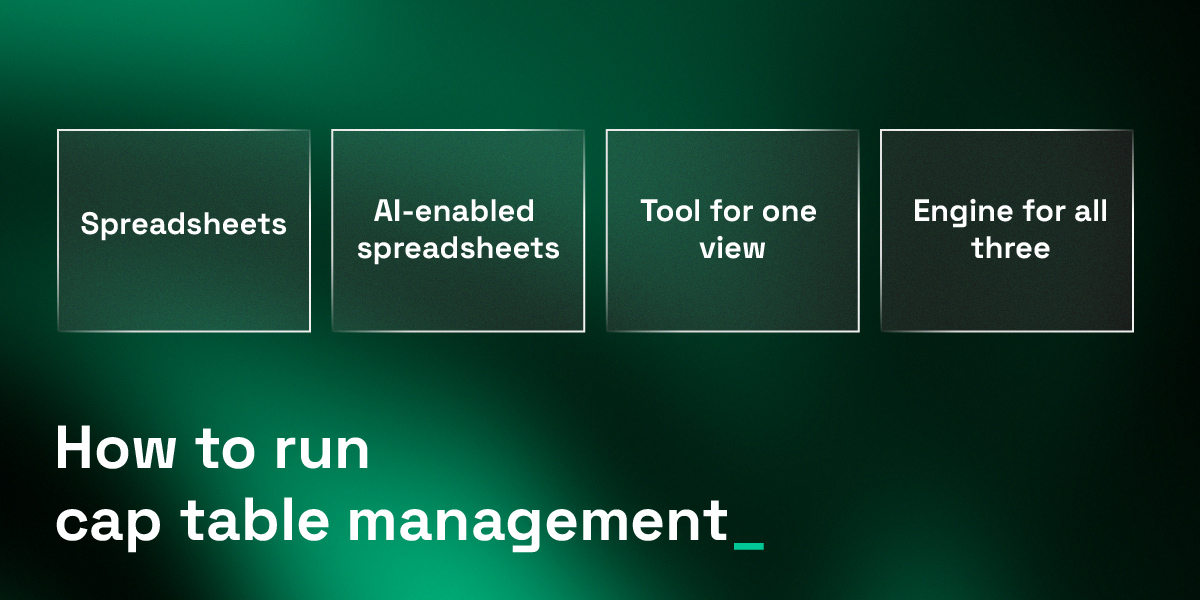

The fund managers we speak to looking for cap table tool, usually weigh four approaches: keep using spreadsheets, add AI to those spreadsheets, buy a tool built for one view of ownership, or use a single system that covers all of them. None is right for everyone. This page sets out what each does well, where it strains, and how to decide.
First, which view of ownership do you need?
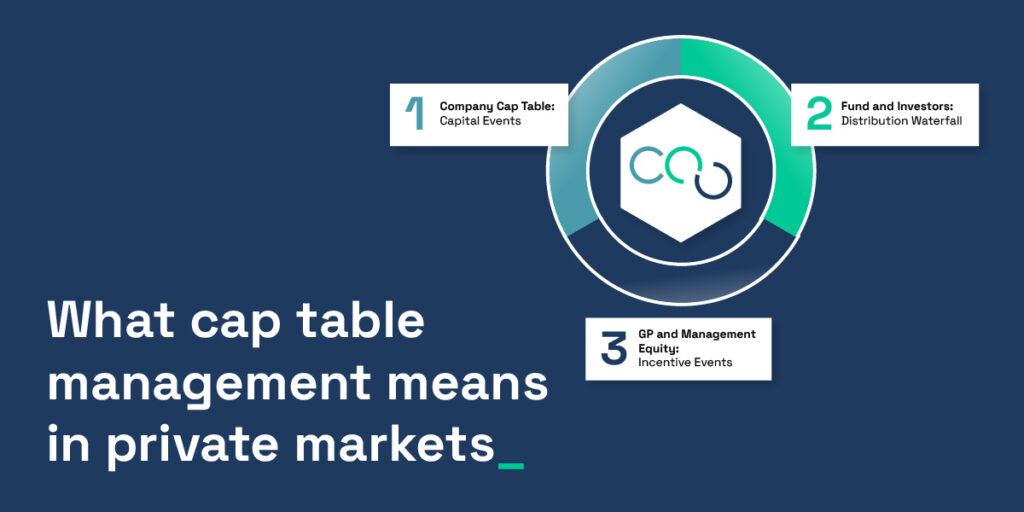
In private markets, “cap table” can mean three things, and most tools are built around only one of them.
- The company view. Who owns what in a company or vehicle: ownership, voting and control, and share classes.
- The fund and investor view. Who the investors are, what they put in and what they receive, through the distribution waterfall.
- The GP and management view. Carry, management incentive plans, points, vesting and leavers.
These three are connected. An exit in a company flows into the fund, and from the fund into carry. The question for any approach is not only whether it covers one view, but what happens when numbers need to move from one view to the next. More on this here.
Option 1: Spreadsheets
Where they work. Spreadsheets are flexible, familiar and cost nothing extra. For a one-off calculation, a small structure or a quick sense-check, a spreadsheet can be the easiest tool, and in principle it can cover any of the three views because you build the logic yourself.
Where they strain. The same flexibility is the risk. Spreadsheet are prone to errors and logic lives in the head of the person who built it, making it hard to control which copy of a model is current. Many organisations still consolidate data into spreadsheets by hand, which becomes harder as reporting requirements grow (Nasdaq, August 2026).
Additionally, building spreadsheets may introduce inconsistencies when the same model is implemented in different ways (e.g. by different people).
Option 2: AI-enabled spreadsheets
Assistants built into spreadsheet software can now draft formulas, explain a workbook and help build a model in a fraction of the time.
Where they work. Speed. An AI assistant lowers the effort of building and exploring a model, and it is useful for quick drafts and for understanding a file you did not build. AI has become much better at building financial models, though it still needs close human review.
Where they strain. The logic still lives in cells that someone has to maintain, and the assistant adds a new thing to check. In a purpose-built, deterministic engine, by contrast, the logic is set up once, tested and applied the same way on every run.
Additionally, the introduced inconsistency we mentioned in Option 1 is also relevant here. One example could be implementing the same model with different prompts.
Option 3: Tools that cover one view
A third approach is to buy a purpose-built tool for the view you need most. Company cap table tools focus on the company view. Fund administration and investor register tools focus on the fund and investor view. Incentive and carry tools focus on the GP and management view.
Where they work. A tool built for one job usually does that job well, with a clean workflow and depth in its own area. If you only ever need one view, this can be a good fit.
Where they strain. Each view stays in its own place. When a company is exited, someone still has to move the result into the fund calculation, and from there into carry, usually by export, import or retyping.
Option 4: One engine for every view of ownership
The fourth approach is a single system where all three views run on the same calculation engine. This is how qashqade works: the company cap table (capital events), the fund and investor waterfall, and GP and management equity (incentive events) share one engine, with add-ons depending on the use case.
- One connected chain – end to end. An exit is recorded as a transaction and flows downstream, in the order of the structure, into the fund waterfall and then into carry.
- Any vehicle structure. Multiple legal entities, feeder vehicles and separate vehicles for different investor groups.
- Simulation. Add exit scenarios, valuations or transactions to a scenario.
- Controls. Optional second-set-of-eyes approval, a metadata sheet with the steps and setup behind a calculation, an audit log of setup changes, reconciliation between runs, and documents attached to events.
- Stakeholder publishing. Share each investor, shareholder or carry holder’s own data through the Portal, with a preview before release.
What to keep in mind. Every client has its own calculation mechanics, so it is worth talking through yours early. A walkthrough on an example structure shows how the engine handles share classes, vehicles and incentives, and specific mechanics are confirmed in conversation.
The four approaches side by side
| Spreadsheets | AI-enabled spreadsheets* | Tool for one view | Engine for all three | |
| Company view (capital events) | Possible, built and maintained by hand | Possible, faster to build, still checked by hand | Core strength of company cap table tools | Covered |
| Fund and investors (waterfall) | Possible, often complex and hard to check | Possible, faster to build, still checked by hand | Core strength of fund-side tools | Covered |
| GP and management equity | Possible, often a separate file | Possible, faster to build, still checked by hand | Core strength of incentive tools | Covered |
| Exit through to carry | Manual links between files | Manual links, possibly AI-assisted | Handoff between tools | One chain, in the order of the structure |
| Scenarios | A copied file or changed cells | Faster to set up, outputs need verifying | Varies by tool | Covered |
| Change history and approval | Depends on discipline | Depends on discipline, AI edits need review | Varies by tool | Audit log, metadata sheet and second set of eyes approval |
| Publishing to stakeholders | Sent as files | Sent as files | Varies by tool | Portal with preview |
| Best suited to | One-off or simple cases | Quick drafts and exploration, with every output verified; Might need some anonymization of sensitive data (e.g. names of investors / shareholders / carry holder partners | Teams that need one view only | Teams that need the views to connect end to end |
*Might need some anonymization of sensitive data (e.g. names of investors / shareholders / carry holder partners)
This table describes the approaches in general terms. Individual products differ, so check any vendor against your own requirements.
How to choose: six questions you should ask yourself
- Which views do you need today, and as your funds grow? Think about the structure you will have, not only the one you have now.
- Do numbers need to flow between views? If an exit has to reach investors and carry holders, the handoffs matter as much as the features.
- How complex is your structure? Several vehicles, share classes or incentive plans raise the cost of getting it wrong.
- Can you show where a number came from? ILPA’s guidance asks for disclosures detailed enough for investors to validate fees, expenses and carried interest.
- Who needs to see what? Investors, shareholders and carry holders each need their own numbers.
- Does it fit your kind of structure? Ask for a walkthrough on a representative example structure and check that your share classes, vehicles and incentive mechanics are covered.
Talk to us
If you would like to see how one engine handles the company, the fund and GP equity, get in touch for a walkthrough on an example structure: Book a Call