

January 16, 2026

Head of Marketing
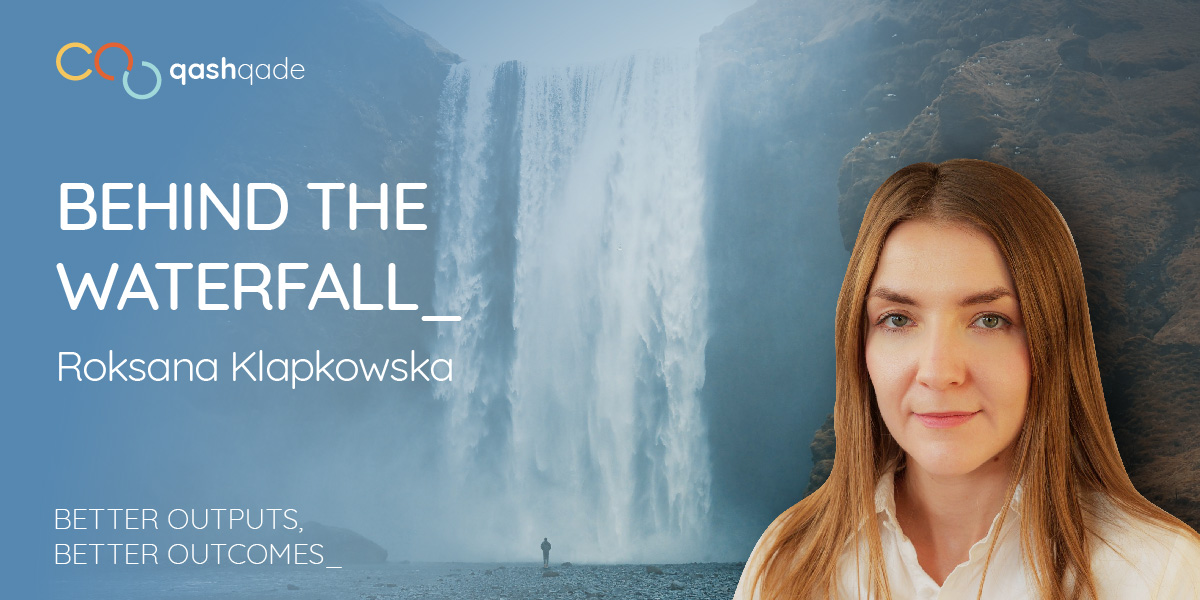
In this edition of Behind the Waterfall, Roksana Klapkowska reflects on her journey from working within a UK pension fund to joining qashqade, and how her client-side experience continues to shape her approach today. She shares insights into the operational and governance challenges faced by asset owners, the growing need for transparency and standardisation in private markets, and the role technology can play in reducing complexity.
We also explore Roksana’s perspective on evolving trends across the private markets ecosystem, what excites her most about qashqade’s latest platform developments, and the impact she hopes to make by helping investment teams operate more efficiently and with greater confidence.
In my previous role at a UK pension fund, I was directly involved in projects related to fee transparency across private market portfolios. Through that work, I gained first-hand exposure to how complex and resource-intensive private markets data can be, particularly when it relies on information coming from multiple external sources. I became increasingly interested in how better tools and infrastructure could support these processes more efficiently. Moving into a service provider role felt like a natural next step, allowing me to contribute to developing solutions that help asset owners manage complexity and scale their oversight as private markets portfolios continue to grow.
My experience gave me a strong appreciation for the breadth of responsibilities investment teams carry, particularly in private markets. Alongside investment analysis, there is a significant amount of operational and administrative work that supports governance, reporting, and oversight. Fee structures and performance metrics are inherently complex, yet they form just one part of a much broader decision-making framework. That experience has shaped how I approach my role today: being mindful of time constraints, prioritising clarity, and focusing on solutions that surface meaningful insights without adding unnecessary complexity for investment teams.
What stood out to me was qashqade’s emphasis on supporting asset owners with clear, consistent information that complements existing GP relationships. The product is designed to make complex data easier to interpret, helping build confidence in the information being used for oversight and reporting. By reducing the operational burden associated with fee and performance analysis, qashqade enables investment teams to spend more time on their core responsibilities, while still maintaining robust governance and transparency.
In my view, one of the biggest gaps in the private markets landscape is the absence of robust, standardised tools for data analysis and record keeping. Information is often received with delays, calculated using differing methodologies, and shaped by fund-specific terms and LPA nuances, which makes meaningful comparison across managers and vintages challenging. This fragmentation reduces confidence in the data and increases reliance on manual processes. Providers like us can help close this gap by delivering structured, consistent, and audit-ready data that improves comparability, reduces operational risk, and supports more informed decision-making.
My interest in private markets was initially driven by their scale and their direct connection to the real economy. The ability to invest in businesses that support local entrepreneurs, regional growth, and long-term value creation was particularly compelling, as was the opportunity to contribute to outcomes related to sustainability, social responsibility, and broader economic impact. Since joining a service provider, my perspective has deepened: I now see even more clearly how reducing operational complexity and improving transparency can create the capacity for investment teams to focus on these long-term priorities and engage more meaningfully with the impact of their capital.
In the UK, a dominant trend has been consolidation, largely driven by the need to reduce fees. As funds grow and combine, transparency and cost control becomes even more important. Solutions like ours will be increasingly necessary to support this shift, and may eventually be encouraged, if not even required, by regulators.
One important lesson is the need for technology adoption to be more closely aligned with the realities of institutional governance and decision-making. Pension funds operate within structured oversight frameworks and high accountability standards, yet technology solutions have not always been designed with these constraints in mind. For the tools to truly be relevant, they need to be intuitive, auditable, and embedded into existing workflows. Only then they are capable of scaling alongside increasingly complex and sizeable portfolios.
What excites me most is the continued evolution of the platform, particularly following the introduction of the latest software release. Having joined shortly before its rollout, I’ve been able to see how ideas and enhancements—originating both internally and directly from client feedback—are translated into tangible product improvements. This iterative, client-informed approach has not only strengthened the platform’s functionality, but has also meaningfully improved efficiency and user experience, reinforcing the organisation’s commitment to building solutions that are both practical and responsive to real-world needs.
I find real value in being part of an organisation that is addressing challenges I’ve experienced first-hand. Contributing to greater transparency in private markets and helping reduce information asymmetry across stakeholders is a meaningful process. It’s important for me to work in an environment where my experience is relevant, my perspective is valued, and my input has a clear purpose. Being part of a business that is actively shaping how private markets operate makes this the right place for me now.
Over the next year, I hope to continue strengthening the connection between client needs and the way our solutions are delivered. My background allows me to understand the practical constraints asset owners face—particularly around time, budgets, and governance requirements—and to view our platform through a genuinely client-centric lens. I aim to help ensure that the tools we provide remain accurate, relevant, and effective, enabling pension schemes and other asset owners to operate more efficiently and ultimately deliver better outcomes for their beneficiaries.


