

June 22, 2026

Head of Marketing
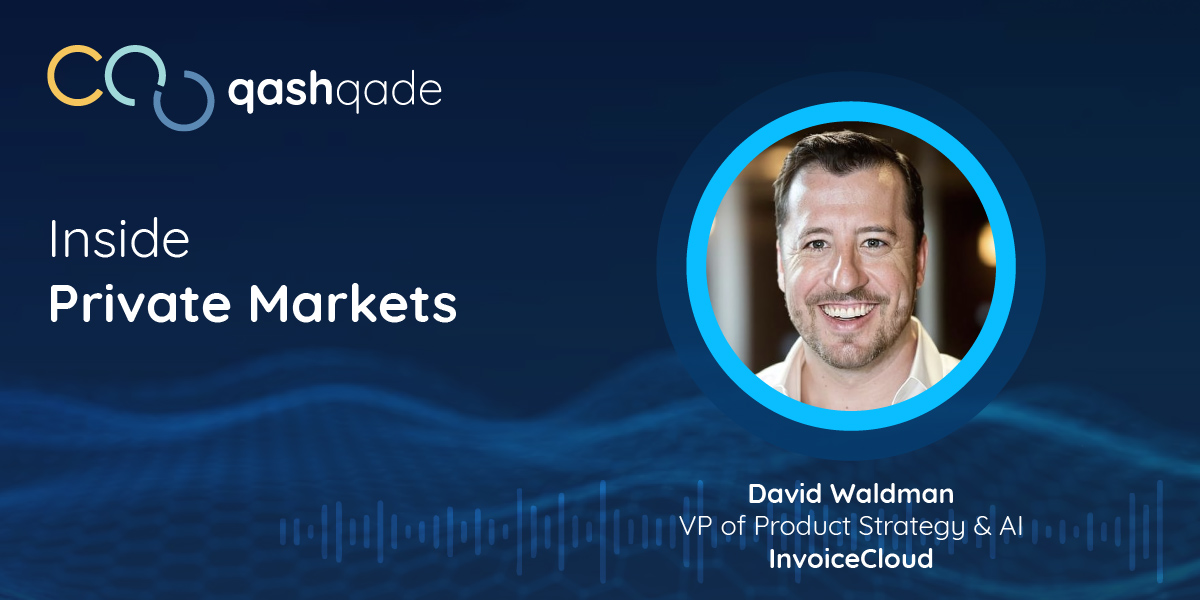
At qashqade, our Inside Private Markets series brings together practitioners and thought leaders who are shaping the future of private markets. We explore the forces driving structural change across the asset class. In this edition, we speak with David Waldman, VP of Product Strategy at InvoiceCloud, whose career sits squarely at the intersection of financial services operations and artificial intelligence. With deep experience in private markets technology and a track record of building AI-powered workflows, David offers a perspective that is rare in this industry: grounded in operational reality, not hype.
David Waldman has spent considerable time lately deconstructing workflows. Not as a theoretical exercise, but as a practical one, taking the tasks that occupy analyst and operations teams in private markets firms and asking a simple question: does this actually require a human? More often than not, he argues, the honest answer is no. And that has significant consequences for how the industry is about to change.
Waldman brings a rare combination to this conversation. His background spans private markets operations, fund technology, and AI product strategy, meaning he understands both the complexity of the asset class and the genuine capabilities (and limits) of the tools being deployed into it.
Ask David where AI has genuinely moved from pilot to production in private markets, and his answer is more nuanced than the industry conversation usually allows for. Adoption, he argues, is deeply uneven and the gap between those moving fast and those standing still is wide.
At one end of the spectrum, quantitative funds have been heavy users of AI for years, leveraging it for trading signals and risk management in ways that are well established. Large private equity managers as well as larger institutional investors have embedded AI to mine vast amounts of context for insights and signals.
"Some of the managers I am speaking to have gone so far as to create a digital twin of a chief investment officer that sits on investing committees."
At the other end, some hedge fund analysts and early-stage VCs David has spoken to recently are not using AI at all and are genuinely convinced it cannot replace their teams.
"One manager described a series of tasks his analyst performs that he felt had to be done by a human, when all these tasks were actually a description of tasks that could be created as Claude skills today."
The real opportunity, Waldman argues, is not in replacing judgement but in decoupling it from the low-value work that surrounds it. When you deconstruct a workflow properly, breaking it into discrete, repeatable tasks and then chaining them together into orchestrated sequences, you free up the people doing that work to focus on the part that actually requires them, first-principles thinking and building digital twins to really pressure test ideas and assumptions.
The adoption gap is partly about time investment and partly about organisational readiness. To truly leverage AI at a professional level, David is clear: you have to invest significant time testing and learning. You have to get over the fear of starting.
For any firm handling LP data, deal information, and proprietary valuations, the question of what can safely be fed into an AI system is existential. And it is a common reason private markets firms cite for moving slowly. David's view is that the industry needs to reframe this entirely.
The starting point, he argues, is straightforward: enterprise agreements. Before deploying any LLM in a business context, the right contractual framework needs to be in place, one that explicitly prevents data from being used to train the underlying model.
"We are almost all using these tools. The question is whether you have set up the enterprise agreements that protect your data. If you have, you are taking the same level of risk as everyone else in that boat. That is a very different conversation from not engaging at all."
For organisations that want to go further, David points to the growing ecosystem of open-weight models that can be self-hosted on private infrastructure, removing the dependency on closed proprietary systems entirely. Beyond the larger foundational models, there is also a meaningful move toward small language models (SLMs), task-specific models from groups like Liquid AI and others that are, as David puts it, incredibly capable and powerful when the task has been rigorously defined. They require more effort to set up and configure, but for well-scoped use cases, that investment can be highly worthwhile.
Meanwhile, AI-native platforms like Harvey, which initially invested heavily in the model layer before recognising they could not keep pace with the rate of foundational model improvement, offer another path: proprietary workflow and knowledge layers built on top of the best available models.
Perhaps the most important practical point Waldman makes is about risk calibration. Chief Risk Officers, he argues, should not be applying a universal policy across every AI use case. Using AI to analyse investor sentiment from email correspondence carries a fundamentally different risk profile than feeding proprietary trading algorithms into a model and should therefore not be treated identically.
If there is one area where David believes the private markets industry is leaving significant value on the table, it is fund operations. The logic is simple: most software in financial services was designed around the assumption that humans would be entering data into systems of record. That assumption is now obsolete.
"There is absolutely no reason that most data entry should not be automated using AI. The work of copying fields, moving documents, filling out forms – these are tasks that AI can do faster and more accurately than people. That is already true today."
Where things become more complex is in what David describes as context engineering, the work of building and maintaining the business knowledge and benchmarks that allow AI to make genuinely good decisions, not just technically correct ones. Knowing that a typical deal cycle in one sector runs 30 days while another runs 90 days is the kind of contextual intelligence that shapes good outcomes. Building the infrastructure to deliver that context reliably is, in his view, one of the most underappreciated challenges in enterprise AI deployment right now.
The regulatory environment for AI in financial services is in flux, and the United States is no exception. The White House's proposed national AI policy framework, which would override a patchwork of state-level regulations, has generated debate about whether it delivers clarity or compounds uncertainty. David's assessment is measured.
The tension between federal and state regulation in the US, he argues, creates checks and balances and allows the system to evolve. But the important context is that no one yet fully understands AI's long-term impacts. Regulation will inevitably need to evolve alongside adoption. The firms that are waiting for complete regulatory clarity before engaging may be waiting a long time.
"We are very early in our journey of understanding AI's impacts more broadly. Regulation will need to evolve as our use and adoption of AI evolves. I don't think anything is fully settled but I also don't think that's a reason to stand still." David's implicit message is to build AI governance frameworks that are adaptable by design, rather than waiting for external clarity that may not arrive on a useful timeline.
Asked for a bold prediction about how AI will have changed private markets by 2030, David does not reach for a narrow use case. He starts with infrastructure because in his view, everything else flows from it.
The cost of running AI models is falling rapidly, and David sees the trend accelerating. Next-generation chips are arriving that are dramatically more powerful and more efficient than today's leading hardware. "The cost of compute will fall progressively," he says, pointing to image processing costs having fallen by 97% in eighteen months as a signal of the direction of travel. For private markets, this means capabilities accessible only to the largest, most resourced firms will gradually become available to a far wider range of players.
That democratization of compute is what makes the next shift possible. The framing David finds most compelling is the shift from scarcity to abundance. The scarcity he has in mind is not capital, but instead human cognitive capacity. There are not enough analysts to go deep on every opportunity.
"You're going to have an explosion in cognition, an explosion in the ability to ask deeper questions and understand more deeply. The potential of abundance to unlock innovation on a truly global scale is so interesting. If we can crack some of this code, we are going to see investment opportunities globally become more attractive as people can explore and go deeper into domains they would never have seen before."
That expanded reach matters especially now, because private markets are simultaneously opening up to a new pool of capital. With individual investors increasingly gaining access to private assets through vehicles like 401k plans and other structures, the question becomes: how does personal capital find its way to the right fund, at the right time, at scale? David's answer is that AI becomes the allocator. The firms that position themselves now as the destination for AI-guided individual investors, building discoverability and transactability into their platforms so that AI allocators can direct personal capital into the right funds, will capture an enormous amount of the growth that follows the unlock of individual savings into private assets.
It is a vision of private markets that looks quite different from today: more accessible, more algorithmically navigable, and ultimately more connected to the broad pool of individual capital that has historically been kept at arm's length. And it is one that only becomes possible if the infrastructure, the cognitive abundance, and the right platforms are all in place.
What comes through most clearly from the conversation is genuine optimism: about the direction of travel, the pace of improvement, and the size of the opportunity for private markets firms that are willing to engage seriously with what AI can do today. The tools are there. The use cases are proven. And the window for building a meaningful advantage is open.
David Waldman is VP of Product Strategy at InvoiceCloud, where he works at the intersection of financial services operations and artificial intelligence. With an MBA from the University of Virginia's Darden School of Business and extensive experience across financial services and fund technology, David brings both operational depth and forward-looking AI expertise to his work.


